Friday, 27 August 2010

Wet Women

Nuzzled within Brick Lane's shopping district, adjacent to The Truman Brewery, sits No 6 Dray Walk; a trendy, urban clothes shop regularly visited by the young fashionistas of Shoreditch. Last night, and for one night only, the bright clothes, white walls and polished wooden floors housed an exhibition of American photographer Amanda Langford's 'Wet Women'.

...and not those kind of wet women before you ask. These glossy prints displayed various bikini-clad women posing underneath a simmering sunlight, each adorned with kitch 80's acccessories, large afros, bold coloured make-up and the last drips of water, which sit comfortably upon their oiled skin.

The electric-coloured photos were orginally exhibitied in the West Indies in 1988, and after their discovery in Langdon's attic years later, have been fully revived for a more contemporary audience. The exhibition iteself was curated by Reinform, a collective of creatives, thinkers and commentators. You can check out their website here, along with more photographs from the show.

Thursday, 26 August 2010

New York Couture

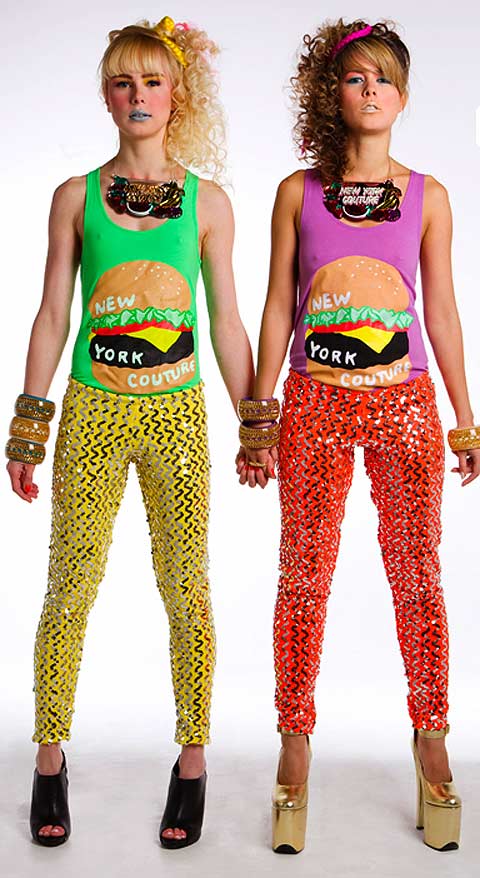
Up and coming fashion label New York Couture revamps the 80's in an amalgamation of Lady Gaga: meets Hello Kitty: meets New York Diner.With it's burger skirts, studded coursets, tight red lycra stockings and glitter frosted leggings, it's certainly been nothing other than a catwalk showstopper.

I'd like to think they've taken an influence from the bright colours and bold images of Pop Art. Infact perhaps next in store we should expect a Campbell's soup mini-skirt? I can see Andy Warhole being smug with that one. Check out the rest of the arty collection here.

Wednesday, 25 August 2010

Diassembled Household Appliances

Art student Brittny Badger takes apart household appliances, placing their individual parts systematically and symmetrically onto a white sheet. Badger says her intention is to explore the 'brains' of each product, allowing us to view them from a very different perspective.

Tuesday, 24 August 2010

Jill Greenberg

I think I've just found my favorite photographer Jill Greenberg, who calls herself 'The Manipulator' which makes me like her even more.

Greenberg borrowed the name from the 80’s German large format magazine "The Manipulator", which covered art, culture and photography and was one of the many pop culture influences along with “The Face”, “Interview”, and “W”.

As you'll see from her website, Greenberg's chromatic, vibrant photographs capture striking portraits of anything from children, animals and music, to abstract locations, pop stars and CEO's. Her style is so attuned to detail that each subject appears like a waxwork; an effect obtained by the use of distinctive lighting and personally-executed post production.

Monday, 23 August 2010

Gum Walls

Check out this wall in Seattle covered in gum. It's hard to get the scale of it from this picture, but since it was begun in the early 1990's, thousands of pieces of gum have been stuck upon the brick, turning it into its very own tourist attraction. There's even a Wikipedia entry about it.

On the wall are messages within each piece- some people deciding to post their hometown or a few even moulding the gum so as to create words about hope and peace.

Since the 'Gum Wall' began there have been reports of other walls of gum created in various communities across the United States, but none to rival this one. Check out some more pictures here.

Friday, 20 August 2010

Taxidermy Is Back In Fashion

About a month ago I wrote a blog on Polly Morgan's taxidermy exhibition and it seems shes not the only artist cashing in on this bizarre artistic trend. Taxidermy is is the display of stuffed animals in innovative yet slightly twisted ways and low and behold the next artist to use such a technique is Julia deville (...now is it just me, or anyone else reminded of the infamous Dalmation slaughterer..?)

And as it happens this would be entirley appropriate. On her rather errie website- full of dark colours and Gothic writing- you can choose to flick through either Birds, Mice, Other Mammals and Skeletons; she even has pieces called 'Bird-Pin' and 'Bird Shoulder Piece' which admittedly look like roadkill simply scooped from the road, and attached to a necklace. 'Sparrow Brooch' is equally as alarming, once again appearing as if the small bird has been snatched from it's nest and strangled by a chain.

But wait for it. There's Kitten Rugs, which are equally as brash; both stretched cats look as if they've been peeled from underneath a tyre and simply stuck on someone's carpet.


Despite this supposedly being a serious art, I did happen to laugh uncontrollably at most of these pieces. Judge for yourselves......click here to see.

Thursday, 19 August 2010

REFLECTIONS

Entitled 'Holiday on The Marina V', Danielle Eubank uses oil paints in this simple but effective painting to accuratley capture multicoloured relfections in water. Having spent months on the International Borobudur Ship Expedition as Exhibition Artist, Eubank is clearly used to these surroundings and has certainly aquired the eye for them.

More recently, Standard Chartered Bank recently commissioned Eubank to produce a portrait for its new headquarters in London, currently under construction. The painting will be part of an international traveling show before it is hung in the London office

Wednesday, 18 August 2010

Olympic Stamps

In anticipation of the 2012 Olympics, Royal Mail is issuing 30 artist designed stamps each depicting an olympic or paralympic sport. the stamps will be released in sets of tens (2009,2010, 2011) - one set each year leading up to the 30th olympiad. For a look at more designs, check out The DesignBoom website.

Tuesday, 17 August 2010

ARTISTIC GROUP: EN MASSE


EN MASSE is a non-profit organisation that brings together emerging Montreal artists to participate in an ongoing series of artistic projects. The group focuses on the creation of large-scale, highly spontaneous, collaborative black and white murals and public installations.

The picture above documents their revamp of Le Petit Hotel in Old Montreal, where they adorned a small awkward space with their black and white murial, transforming the interior.

The EN MASSE Mandate is twofold; firstly to increase the visibility of new young artists, both collectively and as individuals, and secondly, to foster community-oriented art events and programming, built upon a specific form of collaborative interaction and immersion between the chosen artists.

Friday, 13 August 2010

My Favorite Website

This is my favorite website. Especially because I happen to be extremely nosey. The Selby gives you a sneek peak into the lives of the world's top creatives; their studios, homes and hang outs. You can even find out what their cat looks like, what colour their sofas are and more importantly what they hang on their walls. Created by brainchild Todd Selby, a portrait, interiors and fashion photographer, The Selby began in June 2008 as a website, www.theselby.com, where Todd posted photo shoots he did of his friends in their homes. Requests quickly began coming in daily from viewers all over the world who wanted their homes to be featured on the site. The Selby’s website became so popular—with up to 35,000 unique visitors daily—that within months, top companies from around the world began asking to collaborate. I recently purcahsed The Selby's first coffee book, and the photos are really captivating and quirky.

Wednesday, 11 August 2010

Interview With An Artist

I came across Becky Czaicka's work at grad show, and got in contact with her to find out what lies behind her colourful, dynamic portraits. Becky graduated from the University of Huddersfield with a BA in fine art, but has been painting since the age of just 14. Her influences range from Psychedelic Art from the 60's, particularly the work of Wes Wilson and the Coloured Coat to more contemporary influences such as Ben Tour, Tatiana Arocha and Erin Petson.

Steph: Do you mostly do portraits?


Becky: No, I like to draw objects and love just mark making with paint. Since I started painting like I do now, I haven't really had the chance to broaden my content, but I will so when I have the time


S: You paintings are based on pop stars- was this for one particular project or a subject you enjoy representing?


B: It's a mixture of both. We had a brief given to us last November, the idea was to create a campaign to promote the essence and richness of British Music for a museum in London. I chose the brief because I love the cleanliness seen in photographs of musicians and wanted to create a set of images of British Music Icons. It took me a long time to really get into it, and when I got to the last week, I had to start the whole project over again. This is when I developed the style you see now. I found by using the paint in such an expressive way, I could portray the emotion of the music produced by these musicians. I plan to continue doing portraits of Pop Stars and would definitely be interested in album covers and music promotion.


S: Your paintings have a great sense of energy and movement. What are your techniques?


B: I like to use a mixture of paint, ink, glue and anything that can be manipulated when shaking a canvas. Depending on the type of image I am creating, I use different coloured paint and ink onto a canvas and move it around to see how the colours integrate. I love how the glue dries clear and cuts through the colours. For my portraits, I tend to decide on the composition from the original image and then afterwards decide which parts of the image can be more interesting and expressive, like hair for example. Colour palettes are very important to me; it's all about intensity and excitement and I like bold colours as they bring an image to life.


S: What is your end goal? Would you like to have your own show?


B: At the moment, I'm starting to experiment with mark making on canvas and would like to expand my range of content within pictures. I've got lots of ideas in my head as to where my art is going and as long as it's a positive direction, then I don't get too worried about where I will end up. Having my own show would definitely be something I'd enjoy, but I've got a few more years of experimenting to do before I'd be really proud to have a show.


To check out her website, click here.

Monday, 9 August 2010

SepiaTown

Ever wondered what your city used to look like 100 years ago? Now you can with SepiaTown, a website that allows users to upload old photographs of each area. Described as an 'online time capsule' the website's Then/Now feature allows you to compare a historical image to the current Google Street View, or you can map historical events, such as the Warsaw Ghetto Uprising of 1943 or the 1928 UK Suffrage movement.

Friday, 6 August 2010

Body Beautiful

Bill Durgin's interesting photography capturing the flexibility and curvature of the human torso, has certainly made an impression. Hitting headlines in Time Out, Paper and Elle, Durgin takes inspiration from dancers and other performers, photographing the elasticity of human form without heads or limbs.

I'm unsure what exactly make of his works and some would argue that the human body is only beautiful in it's full form, but at the same time, I think it's a clever risk to eliminiate the 'beauty spots' of the body and instead focus on a part that is often overlooked. I also like the way his works are playful on the eye- forcing you to look several times before you can really gather what exactly is on show.

Check out Durgin's website for more figure studies.

Wednesday, 4 August 2010

What Dreams Look Like

Some mornings I wake up and spend at least 15 minutes trying to piece back together the jigsaw of an extremely puzzling dream; one that in concious observation definitely had a start, middle and end, but at the time was anything but sequential.

Leondro Lima's work reminds me of what it would be like to trace your dreams pictorially including every minutes worth of wonderful, wistful wierdness. Or at least mine anyway. They're embedded with that alluring Dali-esque mysteriousness, with one part linking lazily onto the next resembling that all too familiar dream-like sense of foreign thoughts or images connecting and seamlessly blending one into one-another.

Ironically enough, this piece was actually designed for a bank. Ok this doesn't exactly scream 'alternative', but still, good on the bank for trying to be different.

Tuesday, 3 August 2010

Paper Creations

Le Creative Sweatshop have developed a range of weird and wonderful designs made entirely of folded paper. Products include jewellery, window displays, handbags, shoes and installations for brands such as Nissan, Stella McCartney and high-class fashion magazines.

Le Creative Sweatshop is the result of the encounter between Ndeur and Make a Paper World in January 2009: a conceptual agency based of modern communication means and mediums, through the lens of the DIY culture, working on volume and space scenography.

Friday, 30 July 2010

Balloon Breakfast

This charming work was crafted by photographer David Sykes with help from prop specialist Jennie Webster. A giant plate was placed against a wall, and the helium baloons glided upwards to create the best faux-breakfast I've ever seen.

David is quite the specialist at creating fake food. Another favorite from his portfolio is Spaghetti Hoops in which a plate of Spag Bowl is created through winding pasta-like ropes around meatball basket balls. His works are polished by comic twists, espeically some of the adverts he's created for Heinz. You can see his website here.

Thursday, 29 July 2010

Speedos Sculpture

Due to recent changes in swimming competition rules, the LZR Racer Speedo was banned, leaving the brand with hundreds of the products they were unable to sell. Trust Chelsea Art Students however to make use of them. Here we have the first ever sculpture made entirley out of Speedos, featured in London's Architecture Week.

For this particular project, the students were challenged to address issues of sustainability, production and use of materials. Making the most of the swimsuit's high strength textile, the group were able to stretch the fabric to it's limit, connecting pieces together into webs of intelligent design.

Named 'The Pavillion' the final structure was designed using Rhino 3d and Grasshopper digital modeling programs and used 200 of the 600 swimsuits donated by Speedo.

Wednesday, 28 July 2010

Clare Mallison

I spotted Clare Mallison's illustrations on Beautiful Decay-an arts website I follow obsessivley- and was really drawn to her vintage, cartoon like style that oozes the nanchalence of youth and all the warmth of summer. From looking at her blog, I'm clearly not the only one admiring her work; her clients have included Top Shop, The Gaurdian, Elle Magazine and The New York Times and her drawings range from children's pastimes to city scapes. No matter what the siubject matter, all her works are dressed with a child-like nostaligia; the kind where once you've looked at them, you can't wipe the smile off your face.

Tuesday, 27 July 2010

My Mother's Coat

This animation is genius. 'My Mother's Coat' is directed by Royal College of Art graduate, Marie-Margaux Tsakiri-Scanatovits and is based on an interview she held with her Mother about life in Greece. A very promising work for so early on in an artist's career- I expect wonders from this girl.

Thursday, 22 July 2010

Polly Morgan- Pyschopomps

As I read directly from The Haunch of Venison's exhibition catalogue: "All taxidermied animals are either road casualties or have been donated to the artist by pet owners and vets after natural or unpreventable death" I began to realise why this towering gallery space seemed coated with an unusual smell; one that i'd usually associate with dirty hampster cages.

...Or-dead-hampsters.

Morgan's debut exhibit is placed in just one room, containing only three sculptures. The most dramatic piece, Black Fever, hangs heavily from the ceiling like a metallic sculpture, casting a dramatic shadow on the far wall. On closer inspection though, the sculpture is not metal at all. In fact, grey birds wings have been attached together into a tight circular shape to resemble something far more sterdy.

Adjacent to this hangs 'Systemic Inflammation'. Here we see a two winged cornucopias and a cardinal held within an animal's ribcage, lifted into the sky by ballooons. The bright red cardinal is positioned inside so as to resemble a small heart cushioned by the skeleton, and the contrast between the colourful balloons and the blanched bones is quite striking.

To explain this seemingly complex concept, Morgan uses the method of taxiderma, (the stuffing of animals) but instead of presenting them as-just-this, she twists them into something dark and psychological. The name of the exhibition 'Psychopomps' represents mythical creatures that conduct souls into the after-life and, without question, there is certainly a mythical element to Morgan's pieces.

Polly Morgan, Psychopomps, 21 July-25 September


Tatts With A Difference

Who said tattoos aren't works of art? One thing's clear- it definitely wasn't Amanda Wachob. The New York artist behind these intricatle painterly designs focuses on pushing the boundaries of the tattoo medium in order to blur the line between fine art and body art. Her website displays an array of conceptual, abstract and modern designs that look as if they're painted onto the skin using the thinnest paint brush.

Wachob is taking orders at The Dare Devil Tatoo parlour in New York, I'm pretty sure there'll be queues out the door.

Wednesday, 21 July 2010

TIMMMBBERRRR!

These beautifully rustic bar stools are part of an inspiring exhibition in Melbourne that focuses on unpolished, organic materials. The show challenges 10 artists to use 10 different types of recycled materials sourced from either found objects or existing pieces, to fashion into time-honoured furniture or sculptures.

Friday, 16 July 2010

Guerra De La Paz

Living close to a discarded Pepe business in Haiti, Guerra de la Paz took advantage of the store’s abundance of abandoned clothing and focused their artistic brilliance on the histories that lie beneath each piece. This is done by using the clothes to create human-like structures, technically ‘bringing them to life’ and seeming to mould back the wearer.

Guerra de la Paz represents the name of a creative team of Cuban artists Alain
Guerra and Neraldo de la Paz who said “Gaining access to an over abundance of discarded clothing-relics that once helped define an individual’s personality and communally speak of environmental issues, mass consumption and disposability- opened the doors for us to working with garments as a material. We often see ourselves as vehicles guided by their essence and silent histories.”

The group have displayed their work at top galleries including The Saatchi and The Miami Art Museum, and their individualism is particularly striking. Have a look at their website for more impressive sculptures.

Thursday, 15 July 2010

Frank's Bar

Frank's Cafe was commissioned by The Hannah Barry Gallery to accompany their summer sculpture show, Bold Tendancies.

Situated ontop of an old 10 storey car park, the bar and furniture are constructed using old timber and the red roof and ratchet straps were fabricated in a factory that produces drop down canvases for commercial lorries.

The café has panoramic views of London from the Millenium Dome, past Big Ben and the London Eye to Crystal Palace and was completed on a budget of £5000. The whole project was built by an unskilled volunteer workforce in just 25 days.

http://www.practicearchitecture.co.uk/

Wednesday, 14 July 2010

Lee Mawdsley

I'm new to the work of Lee Mawdsley, but already I'm finding it hard to take my eyes off this particular project he carried out for Shakepere's Globe. Mawdsley is a freelance photographer based in London and has already been recognised by Wallpaper, Established & Sons, KSwiss and Design Miami, carrying out a wide range of projects for Gatwick Airport, The British High Commission and Palazzo Grassi.

So admittedly I'm rather late on discovering this one, but I think we'd all agree that his large scale polished photos are seriously eye-catching, even from first glance. Take a look at his website for more.

Saturday, 10 July 2010

The Doors 'When You're Strange'

To coincide with this week’s documentary release ‘The Doors’, Idea Generation’s dramatic photographic exhibition follows the equally dramatic life of this revolutionary and controversial band, through the lenses of four photographers: Henry Diltz, Joel Brodsky, Bobby Klein and Ken Regan.

The Doors were created in 1965 by lead singer Jim Morrison and fellow band member Ray Manzerak. Their first LP ‘The Doors’ shot to the top of the charts, yet concern over their ‘corruption of youth’ made promoters nervous and soon their reputation as bad boys overshadowed their chart success. In fact the Los Angeles quartet continued to relentlessly challenge, confront yet inspire their fans, leaping headfirst into the heart of darkness as opposed to what were the more current popular topics of peace and love.

We’re introduced to Brodsky’s photos first, in which The Doors stand united, huddled symmetrically together like a close knit family. His neat portraits capture them in reflections, or from above where they stare obediently up to the camera. Any hint of violence or rebelliousness is hard to decipher.

Brodsky’s most famous portraits of lead heart throb Jim Morrison are arguably his most successful and are positioned on a far wall across from a barrier which creates a stage-like space between him and the viewer. As I stare into Jim’s eyes, I become yet another fan trapped behind the railings desperate to get that little bit closer. Funnily enough, Brodsky claims that Morrison was “plastered” during this shoot, where he ironically seems so controlled; spreading his arms in a Christ-like pose further reasserting his iconic reputation.

From the look of his photographs, Henry Diltz seems to have submerged himself fully into the world of The Doors. His portraits are less posed than Brodsky’s and we often see them on the move, hanging out at their favourite ‘Ray’s Bar’ or playfully posed in laughter. He’s also included some contact-sheets where we spy The Doors driving in their car, and eating. Simple things yet somehow captivating when done by this group.

Klein’s depcitions are more similar to Brodsky’s, yet he takes The Doors and places them like puppets into various landscapes including palm and redwood trees as well as rocky terrain. They seem so compliant and calm, their unruly reputations dissolved by the strength of their tranquil poses.

My favourite photographer out of the four has to be Ken Regan. As opposed to Diltz’s, Brodsky’s and Klein’s intimate portrayals, he steps away from the band becoming more the invisible voyeur than official photographer and we start seeing them more objectivley. In ‘Jim Morrison, NY, 1970 III’ for example, Jim lies on the floor still clutching his microphone. We cannot see his face through the distance created and thus he becomes less Jim and more like any other rock star in the midst of destroying his set.

To end with a quote from Jim: " It's like gambling somehow. You go out for a night of drinking and you don't know where you're going to end up the next day". If do though, make sure it's at this exhibition.

The Doors, When You’re Strange: 9th July-27th August, Idea Generation Gallery


© Stephanie Wollenberg

Thursday, 8 July 2010

The Elephant Parade & The Vadar Project

If you live in London, I'm fairly sure you'll have seen atleast one of the 250 elephants placed around the capital this summer, each one individually designed and crafted by various artists and designers including Jack Vetriano, Matthew Williamson and Jeff Hoare. With a host of celebrity supporters and arguably faultless PR, the Elephant Parade has proved to extremely succcessful in raising awareness. In fact, after a recent auction, a grand total of £70,000 was raised towards the charity ElephantFamily.org.

Another similar project that delves slightly more into the dark side of art is 'The Vadar Project'. Again, 100 artists and designers customized replicas of the Darth Vader helmet transforming the mask of the menacing villain into individual works of art.

Unlike the elephants though, this exhibition has been touring for 4 years and is soon to come to an end in Freeman's Auction House in Philedelphia. Curated and produced by Dov Kelemer and Sarah Jo Marks of DKE Toys, the Vader Project is on view at Freeman’s from July 5-9, followed by the auction on July 10. The show also includes a vibrant limited-edition catalog featuring full-color photographs of each helmet.

Tuesday, 6 July 2010

Francoise Nielly

French artist Francoise Nielly looks back to her first memories of colour to construct these stunning portrait pieces, sculpted with ardous energy using oil paints and a palette knife. "I have vivid images of colors, of brightness" she says, "yellow, sunshine, blue, heat, cicadas, pin smell, light...all of that classical imagery of South France is very alive as an experience inside of me. Maybe it is what led me to the use of fluorescent colors in my paintings".

Neilly is equally inspired by urban graphiti, drawn to it's untamed wildness that seems to scream from her own paintings. If you're interested in seeing some more of her paintings, her website has a stunning collection.

Sunday, 4 July 2010

The Family and the Land- Sally Mann

Sally Mann’s photographic exhibition- her first in the UK- merges the themes of natural life, death and progressive time through the use of her duteous children, dramatic landscape and decomposing corpses.

The show begins with her ‘Immediate Family’ series (1990-1996) consisting of close-up, black and white portraits of her three children, Emmett, Jessie and Virginia captured over a period of 10 years. Often they are placed in close proximity to the lens, which disguises the sweetness of their faces. Instead they become blurry and stone-like in an almost statuesque quality however some endearing elements like Virginia’s weighty freckles, manage to open up a sense of tangibility.

The juvenile title of each photo echoes those found in story books: ‘One Big Snake’, ‘The Aligator’s Approach’ and ‘The Perfect Tomato’ yet Mann’s works exude none of this expected excitement and anticipation. In fact strangely enough, despite being so close to evidence of childhood, her photos seem haunting and deathly. The children neither smile, nor in fact make any suggestion that they are indeed young. In their structured poses there’s a strange adult-like quality, as if Mann has deliberately positioned them so as to remove that genuine innocence and unpredictability one would expect from children impatiently waiting to be photographed.

Mann’s photos are blotchy and marked in places resembling those buried in the back pages of an old album; an aforethought result of Mann’s wet-plate collodition process. This complex technique allows photographic negatives to be produced using a glass plate collodition which forms an emulsion. The plate is then sensitised in a silver nitrate solution and exposed to light whilst still wet, resulting in dust and dirt seeping into the surface. This effect adds to the timeless nature of her works that look archaic and vintage in their scuffed quality.

Upstairs we’re invited to watch a film directed by Steven Cantor directly addressing Sally, her life, and the story behind her works. Contrary to the conventional nature of most artist documentaries, we see Sally walking her dog in her beautiful homeland of Virginia, feeding her goat, horse riding and playing with her children. There is absolutely no pretentiousness to this artist- and the film’s simplicity compliments that found in her art.

In the second stage of her work ‘Deep South’ (1996-8) Mann’s children play less of a major role as she becomes preoccupied with landscape and the effects the American Civil War had upon it. For example we see a ‘Scarred Tree’ and ‘Swamp Bones’, the former’s bark slashed across it’s middle, and the latter a misty graveyard of wild tree roots resembling twisted skeletons. Mann’s exhibit continues to become darker in mood as you walk into the final room, so much so that we are greeted with a warning before we step in: ‘Some visitors may find the photographs in the next room challenging’.

Having been lulled into the exhibit by promises of youth and energy, we are now halted wondering whether to enter this final room. The next daunting series called ‘What Remains’ 2001, shows photographs of decomposing corpses placed against the ground and seeming to absorb into the land. In one, an old man lies face down, the skin on his back bunched and gathered to resemble thick, aged tree bark, and another shows the light illuminating the blonde hair of a young boy, whose face has thankfully been blurred out. It is here that we start to see connections throughout Mann’s work and realise how effortlessly her exhibition has progressed from birth to death in only three small rooms. The transition between the two never becomes overly apparent and therefore cleverly mimicks the journey of life.

Sally Mann, The Photographer’s Gallery, 18 June-19 September 2010

© Stephanie Wollenberg

Friday, 18 June 2010

Secret Cinema- So Much More Than Film

“Welcome to Utopia” said the policemen who greeted me, dressed head to toe in futuristic black uniforms and armed with batons and megaphones, their eyes shaded by large black glasses and visors. Mannequin-like air hostesses are soon to join, taking my hand and guiding me toward the queue which is has begun to wind its way around Canary Wharf’s banking district.

This isn’t one of those strange dreams where you wake up wondering what you ate - just the freakishly imaginative world of Secret Cinema, who by the looks of things, had really gone to town.

Coming from the speakers I heard the tinnish voice “Welcome to your new life. You have been specially selected on this journey” and bewildered businessmen looked about with confusion upon the growing crowds, who turned up in their hundreds decked out in goggles, turbans, vagabond hats, Oriental clothes and futuristic dress; just a handful of Secret Cinema’s specified uniforms for the night.

Once all were handed their ‘Utopia Airways Ticket’, we were escorted by anxious security teams and policemen in long brown overcoats to an abandoned warehouse. During this walk, the guards weaved in and out of the crowds speaking manically into radios and warning us to “Keep your goggles on. There’s Acid Rain approaching. This is a military operation”. As we approached the warehouse, passing huge freight containers and dipping through an alley way, we were accosted by Asian street sellers, over-head gangster fight scenes, ‘acid-rain’ and a man who sat in a trolley singing to himself in a trance-like state. In all honesty, I found him the most alarming.

Inside though is even better. The warehouse is dingy, and the ring of drum and base music and haze of the smoky atmosphere resembles a dingy rave of the 80’s. Here, we’re accosted by a selection of nutty professors building human body-parts in dusty laboratories, robot- heads, real live pythons, call girls, street stalls selling sushi, smashed up cars, live bands and roaming actors in black trench coats.

Now, can you guess the film yet?

Secret Cinema was founded in 1997 by Fabien Riggall, who was undoubtedly influenced by the secret Speak Easy gatherings of the 1920’s. Though Secret Cinema began in London, parallel events now take place in Brighton and periodically in other cities across the UK and the phenomenon continues to gain popularity, with tickets selling out almost instantly.

Although claiming to be a ‘cinema’ experience, Secret Cinema is arguably an art in its own right. Creatively combining theatre sets, live music, dancing, acting, AV and film, they bring to life an engrossing, multi-sensory experience; in fact even while the film is shown in the make-shift cinema space, actors are spot lit hanging from wires on the wall, re-enacting that famous fight scene.

If I look at Secret Cinema from an arts perspective, it’s not surprising that it’s so appealing. In a world where installation art is starting to prevail over the static canvas, Secret Cinema celebrates this notion of engagement, encounter and more importantly, entertainment.

Haven’t guessed it yet?

Blade Runner. But Tell No One.

Wednesday, 16 June 2010

Introduction to Press Release Written to Promote Malta

"If Malta were a man, he’d be an enviously ideal date. Seducing you with a touch of romance, a light drizzle of British charm, irresistible charisma complimented by a cheeky, wild side; it’s alluring and subtle sophistication would wrap you into its arms, leaving you wanting so much more than just a summer fling. Luckily for us, Malta’s charm isn’t temporary. With traditional fiestas, jazz festivals, chic club nights and a lusciously warm climate extending far beyond the summer months, Malta’s in it for the long term. So get ready girls (and boys) as you fall helplessly, and utterly, in love - every month of the year."

Tuesday, 2 March 2010

Prix de la Sculpture Noilly Prat 2009


After what was described as 'months of extremely intensive work and a serious number of all nighters', four bleary eyed, London based Bartlett graduates: Kevin Green, Frances Reynolds, Ned Scott and Greg Nordberg, entered the Noilly Pratt sculpture competition. The aim was to encourage the creation of sculpture using natural materials that explored the qualities of the natural environment; the chosen piece would sit in Noilly Pratt's beautiful courtyard.

Insisting they 'only entered the compeition as practise' the foursome quickly won the UK round with their edgy, eccentric design. After being whisked off to Paris for the grand final, where fierce compeititon from US and French finalists and a panel of judges awaited, they were successfully comissioned 22,000 Euros to build their sculpture.

The sculpture is composed of two intertwined shells, each constructed of 200 staves of steam-bent green oak. Each stave was soaked for 2 days, steamed for 45 minutes, and bent over two custom moulds to create a unique curve and twist. The inside surfaces are charred and painted with varnish containing a combination of herbs and spices. The two shells wrap around eachother to form an enclosure in which the air becomes infused with the wonderful scents of camomile, nutmeg and orange rind.

This is not the only inspiring and somewhat fanciful project to be presented by the foursome. Currently illuminating the windows of Farringdon's Cosmo bar is a whimsical display of moving bicycle wheels, attached to an engine with gears, each jazzed up by fairy lights. The wheels continue to move up and down, manically spinning at random intervals so that passers by stop inquisitivley.

With such raw talent, I wondered what 2010 would hold for these talents grads. 'We'll certainly be entering more competitions' says Frances, who claims they're now armed with a fiery ambition. 'Obviously we need to come up with a collective name, and then, well world dominance of course'.

Thursday, 10 December 2009

Maharaja: The Splendour of India's Courts

The history of India is explored to the richest level in the V& A's sensory seductive exhibition 'Maharaja: The Splendour of India's Courts'. As the doorman pushes the gallery's thick, golden door aside, you are welcomed into the bejwelled gallery space full of the luxurience of an Indian Kingdom. The rooms are abundent with the finest of jewels, robes, cars, paintings, photography and film all reveling in the affluence and exuberance of the Indian Royal Courts.

A large model elephant, dripping with jewelled body pieces greets you in room one, and from here onwards the theatricality of the curator becomes evident- I even found myself dancing as I walked round the exhibits to the ryhtms of the Indian drum.
A highly impressive, beautifully curated exhibition. Well worth a visit.
10 October-17 January 2010. The V&A.

Sunday, 6 December 2009

Jim Goldberg: Open See


Upstairs on the second floor of the newly situated Photographer's Gallery, lies Jim Goldberg's modest photographic exhibition, Open See. Through a series of polaroids and other memorabilia, Goldberg documents the experiences of people from socially and economically repressed countries attempting a new life in Europe.
The exhibit begins with snapshots of troubled and traumatic lives including those of trafficked women whose faces are mostly scratched out to protect their identities. They stare sorrowfully into the camera, their individual tales of torment scribbled below their photo. We're also presented with an array of bullet brushed skin peppered with protruding keloid scars and a vegetable collector who, curled up in his basket to sleep, tucks himself up in a white sheet. His limpidity resembles that of a dead body, appearing to be wrapped it's very own body bag and Goldberg's deliberate sense of foreboding continues to hang heavily throughout.

Goldberg's photos are extremely hard-hitting in their extremity yet, all at the same time, their honesty transforms into something particularly beautiful. In 'Man with a Goat' (above) Goldberg captures a Bangladeshi holding up a dead goat that he has salvaged from the rubbish engulfing him. Although clearly victorious with his catch, there is a sense of helplessness here; he appears lost at what to do next, as if, within the short moment he has allowed himself to relax, he has looked around, only to see the sadness of his pitiful situation dawn upon him.

My true favorite, was 'Girl in a pink dress' taken in Senegal. A young girl, with skin as jet black as the night, balances upon her 'castle'- a pile of rubble. She wears a striking fushia pink dress and small green flipflops and loiters all alone. With no other kids to play with, she is singularly foregrounded by crumbling grey stone walls drawing your eyes instantly to this colorful centerpiece. Standing tall, she resembles a last remaining flower in a concrete jungle, poking it's head through a barren landscape, void of any other sign of life.

Quite often in Goldberg's photographs, people stand alone or appear to be wondering, with no evidence of where they started or where they will end up. Scribbled underneath or over the top of the polaroid portraits are individual stories-one reads-'I have no where to go since there is war in my country. Now Greece does not want me where can I go?'.

This exhibition intentionally never reaches a climax. Even the photographs of Europe show images of suffering and pain, suggesting there is no true escape for these people. To further bring the journey to life, Goldberg's diary lies open in a glass cabinet in the centre of the room along with an email sent to him by a man named Eid Mohammad. Eid's message explains his despairing situation, ending with a desperate plea to Goldberg: 'My only hope is you. Have a nice life'. It was here that I too suddenly became aware of my situation, but unlike the man with the goat, my incredible luck in life slowly dawned upon me.

I do recommend this exhibition, although so impressed with it's scope and content I slightly wished it had been expanded into sculpture or even installation to create a more rounded experience. For those who happen to be in Oxford Street fancying a break from shopping and the crowded streets, this exhibit doesn't take an awful lot of time to walk around and there's a lovely cafe on the top floor where you can truly rest your feet.

Exhibit on show 16 October-January 17.

Sunday, 15 November 2009

The Taylor Wessing Photographic Portrait Prize 2009


Taylor Wessing, for all those that don’t know, is a law firm so their sponsorship of a photographic portrait prize at The National Portrait Gallery seems a rather odd partnership. Scanning the exhibition catalogue for an explanation as to how these two became such comfortable bed fellows, I find that apparantly both institutions strive for the same goal- excellence- and it is this that 'brings them together'. Whether or not this is grounds for justified partnership, i'm not convinced, yet despite this slightly unconvincing pairing, the exhibition does not disappoint.

The Taylor Wessing Photographic Portrait Prize encourages and cultivates new talent, whilst emphasising the importance of hard work and a forward thinking, creative attitude. In fact most of the photos in this exhibition are so striking and compelling that ‘excellence’ is once again ill fitting- an undersatement even.

My particular favourite is Oli Kellett’s photo of ‘Emma’ laying back into a cushioned pink sofa, staring out of an unseen window. Uncomplicated and peaceful this image really struck a chord with me as I could quite easily picture myself sitting in that same chair, looking out of that same window simply watching the world pass by. ‘Hannah’ by Gino Spiro is a more sombre portrait but equally as captivating. This nervous looking girl, framed by a dark black background, stares directly at us, the self harm marks on her arms in full view. They lean stiffly against her naked body acting as her barrier from the viewer who feels uncomfortable in the intimacy this photograph demands.

‘Group Of Friends At Barceloneta Beach’ by Lluis Artus is more light hearted, rousing a few sniggers as visitors, particularly women, scampered past it. Artus presents a group of tanned, over weight Spanish men in tiny speedos who stand grouped together staring gallantly into the camera; their bodies shimmering with tanning oil in a pose attempting intimidation but rather revealing a close friendship between them.

Another provocative portrait was that by Carol Allen-Storey ‘Forgotten Woman Of Genocide’. Here a distressed lady pulls up her shirt to reveal a severe laceration scar running along the bottom of her rib cage. Tears stream from her eyes as she looks down upon it and the giant crack running down the wall that she sits against echoes her disfigurement. ‘Huong 19 In Hanoi’ from the series ‘A War’s legacy- birth defects in Vietnam’ is truly shocking. The portrait displays a man born with no eyes, not even the sockets; just one of the many horrific consequences of nuclear bombs.

This exhibition is very moving and I would strongly recommend it. My advice however is try not to go on a Saturday, as it gets extremely busy and it’s difficult to stop and really take time to look at the works.

The National Portrait Gallery, Free admission, until February 14 2010.

At By Offenders: From the 2009 Koestler Awards


The Koestler Award is evidence that art can change lives. Attracting over 5,000 entries a year from inmates of prisons, young offenders institutions, secure psychiatric hospitals and immigration removal centres, it’s aim is to help and motivate detainees to participate and hopefully achieve success in the arts. The awards also increase public awareness and understanding of the ideas and experiences of prisoners and patients throughout the UK.

This exhibition gives a touching insight into the lives locked away from public view. Most works, that range from carved wooden boxes, to sculptures, to oils on canvas, were labelled with ‘Anon’. The only evidence of the artist’s identity was often a small set of initials hazardously and somewhat coyly painted in the bottom corner. I was instantly surprised at how brilliant most of these pieces were- they could easily have been mistaken for the work of accomplished, trained artists and I questioned where all this incredible creativity and imagination arose from bearing in mind their oppressive and mundane surroundings.

One particularly touching work was ‘Bug Life’. Over the space of 2 ½ years stuck within the same prison cell, an inmate had named and collected every single bug that had lived and died around him. He then stuck their bodies on to a canvas, along with their name, date and reason of death. The feeling of this man’s loneliness was heart breaking here. The fact that he valued the presence of an insect as company reflects the desperation of so many prisoners and patients perhaps unable to connect with others on a human level or so isolated that they have little choice but to seek companionship through other things.

Another great work was a prison pillow that had written upon it a letter from a father to his son, whom he had never met. The image of this man’s sleepless nights were at the forefront of my mind and his anguish was evident right through from the obvious speed of his messy writing that claimed ‘Daddy’s gunna come back soon’ to the pillow’s evidential creases of his insomnia.

‘After A Visit’ was a simple painting that was extremely thought provoking. An anonymous inmate had painted a man sitting in a chair, holding his face in his hands. On top of his face appeared to be another, as if he were putting on a mask. His huddled over body language and un-smoked cigarette in his hand showed that this man was experiencing deep emotional pain. On the panel beside the painting, the artist stated that his work represented the difficulties prisoner’s face when trying to speak to families during visiting time. He explained that most inmates put on a ‘new face’ when they see their loved ones, attempting to protect them from knowing the truth about prison life.

‘Freedom’ was a fantastic painting depicting a man standing on an empty beach, looking out into the ocean and raising his arms up in a gesture of accomplishment. My own freedom and ability to have independence did dawn upon me at this moment and although the painting was ultimately sad, it was hopeful too.The exhibition also included a poetry book with prisoner’s poems written in it. I sat and read every one, and each seemed to repeat the same themes of longing, endless running away and craving for love and affection.

At the end of the exhibition you are encouraged to vote for which painting you thought deserves to win the Koestler Award. The chosen artist will receive support toward his art for a year after he is released in the hope that his creativity will continue.

The works in this exhibition are extremely poignant, and upsetting though some may be, it is also uplifting to see that art can indeed offer the mind a little peace and reflection that so many of these troubled artists need.

The Royal Festival Hall, Free admission, Until December 2nd.

SHOWstudio Fashion Revolution At Somerset House


The illustrious world of high-fashion has always been untouchable; exclusively produced, pampered and previewed by only the hands and eyes of the elite. To most others, high-fashion is a somewhat alien even carnivalesque art form, more often than not seen statically from the pages of a magazine. It is rare therefore that the energy, unpredictability and ruggedness of fashion is witnessed by others except photographers, designers and stylists. Infamous fashion photographer Nick Knight however is gradually changing things.

Knight has curated and designed ‘SHOWstudio Fashion Revolution’ currently on show at Somerset House. His cleverly thought out exhibition catapults you right into the face of fashion; leaving you so close that as you walk out the exit you feel as though you could recall in detail every one of it’s sounds, smells and intricacies.
Inspired by his website (Showstudio.com) that literally translates as ‘show the studio’ Knight believes that the internet is changing the way fashion is perceived. “The internet allows for a whole new relationship, a two-way communication” he says, “where the audience participates in art, interacts with art and shapes its path”. Thus, I get to work in doing just this throughout Knight’s extremely interactive exhibition, whereby we decide how the final product will look.

In the first room I found myself looking up to three giant white sculptures of Naomi Campbell. In front of her, was a small computer screen that bore the outline of the sculptures, and an electronic pen with pallet of colours encouraging you to ‘decorate’ her however you would like. These computer based scribbles were then instantly projected onto her white torso, and like a child with a set of new crayons, I found myself colouring in Campbell for at least 30 minutes. To create the sculptures, Knight used 3D scanning technology from a photograph; the deliberate procedure of which intentionally inverts the process of fashion shoots where the photograph is the end result of creativity as opposed to its product.

Another really innovative installation was Banquet (2004), based around a commission from W Magazine to photograph luxury eveningwear. The shoot was based around a twenty-three course banquet cooked by Heston Blumenthal, attended by a host of famous models. A webcam was set up looking down upon the plates of each of the attendees, and Knight projected every one of these separate films onto a table covered by a white cloth. The meal was also recorded, and therefore audio was also played. As a result, Knight had re-created this meal, yet all you could see were the images of hands tucking in to half finished main courses surrounded by the murmurs of conversations. Standing watching this felt invasive yet alluring and I wanted to stay to watch each and every plate scraped clean in an attempt to guess who the anonymous eaters may be.

Knight brings you closer still to these untouchable fashionistas through Phonecarte (2004-2008) whereby Lilly Cole, Karen Elson, Irina Lazareanu and Lily Donaldson were instructed by Knight to leave chatty voicemail messages from their various fashion shows, describing what they were doing, how they felt and generally divulging personal information. As I picked up each receiver, I thought about how rare it was to hear the sound of a model’s voice, in fact I was quite taken aback that to the eye these women are so extraordinary, yet to the ear so very ordinary.

The last installation I thought really reflected Knight’s theme well, was Dress Me Up, Dress Me Down (2005). Here the role of stylist is handed over to us and from a touch screen, you are able to select various different outfits from a virtual wardrobe of items, eventually creating one complete ‘model’ out of a differently styled head, body and legs.

Whether you are into fashion or not, I really recommend this exhibition, and at £5 I thought it was money well spent. What a great idea to allow us a gritty insight into the heart of fashion, divulging and revelling in it’s unpredictability, creativity and restlessness. Other highlights included a clothes soudscape, Brad Pitt performance piece, and a film that recorded models sleeping.

Friday, 15 May 2009

A Theatrical Space


Many would say that a theatre’s magical atmosphere lies not in its structure, but within the relationship between its audience and actors. It is hard to forget, for example, the enchantment that arises from the dramatic dimming of lights, promptly followed by an anticipant silence that is sliced sharply by the power of an actor’s first line. Spanish photographer Raul Belinchon is similarly drawn to the theatre, yet believes the space is at its most powerful when completely empty.

In his latest project ‘Stalls’ Belinchon has photographed the immense deserted interiors of a number of infamous theatres, including Paris’s grand Bastille, St Petersburg’s eminent Marrinski and London’s lofty Royal Festival Hall. With camera equipment in hand he walks centre stage, positioning the former outward. As a result, one is faced with row after row of empty seats that return your gaze as they seem to morph into shapes of countless bodies.


Belinchon began studying photography in 1996 and seems to enjoy this play with perspective as he says ‘Theatres, without spectators, without actors or actresses, are stages within stages’. As I took time to closely study these photos, Belinchon’s description becomes very apparent for I felt immediately as if someone was hidden within the wings- watching me. My subsequent self-consciousness thus forced my eyes to search frantically over the photographs in an attempt to seek out this voyeur; of course to no avail.

Despite this haunting and slightly tense atmosphere Belinchon creates, one cannot ignore how graceful and elegant theatres are when uninhabited and free from distraction. The animating glow of the lighting and perfect linearity imbues them with an eerie anthropomorphic quality; they appear to have a life of their own. The architecture is vast, and always topped by the most striking ceilings, my particular favourite is the Apollo Victoria, whose blood red seats are enhanced by fluorescent purple lighting that crawls over the ceiling; mirroring the tentacles of some rare under water being.


Belinchon is not alone in his infatuation with the abandoned theatre space. Portuguese painter Gil Heitor Cortesao (exhibiting this summer at Carbon 12 Gallery in Dubai) has a similar objective. His painting ‘Remote Viewer 2’ 2008 also depicts the seats of an empty theatre, and once again we are placed centre stage with no apparent audience to watch us.


This work seems slightly less austere, perhaps due to the paints softness that helps to dumb down Belinchon’s uncanny realism, yet both artists share the ability to toy with the notion of the observer. Through a manipulation of perspective we are forced to question who the real act is, or more relevantly, what is the real art form: is it the observer, whom in the artist’s illusion appears to be the subject of performance, or is it the theatre itself, that too takes on human form? No matter what the conclusion is here, the crucial element in any successful work of art is that of mystery and both Belinchon and Cortesao’s ability to leave one wondering is exactly why their work is so resonant and compelling.

Monday, 12 January 2009

Mark Rothko Exhibition


More than a quarter of the way through its showing and Mark Rothko’s exhibition is still brimming with people. Within the main room, businessmen sit dreaming away their lunch hours, an old lady quietly muses in the shaded gallery space and a collection of lovers relax languidly arm in arm, lost in the colossal canvases before them.

Hung from all four walls just above eye level, the paintings bear down upon viewers so that one feels surrounded by them in a protective circle, somehow safe and free from harm. This shielding effect is heightened by the dim lighting of the room, resembling a church’s sheltering interior and one cannot help but to feel touched by an element of the spiritual.

There is little movement; people stand as still as his paintings, taken aback, overwhelmed even, and amidst the room’s silence and all-encompassing stativity, one can still hear muffled whispers of constant discussion. From atmosphere alone therefore, it becomes clear that Rothko’s works, are not to be, and simply cannot be, passed by.

His ephemeral landscapes of oranges, reds and maroons are made up of cloudy outlines; forms devoid of concise linearity yet resembling the smudged imprint of squares and rectangles. His paint, built up layer upon layer creating an illusion of depth, is akin to the colours and fluidity of molten lava, and as one spends time with these fascinating works, more subtle shades, hazy nuances and hints of ghostly forms gently emerge from the canvas.

It is only a matter of time for instance before one begins to see small patches of white reflecting off the low light, as if Rothko were demure enough to reduce his signature to the marks of his own fingerprints. His works are warm and welcoming; appealing in their simplicity, as if each brush stoke were somehow laced with understanding and compassion.

As one enters the final exhibition room, the Rothko, previously so easy to establish a rapport with was now not so welcoming. Hung just at eye level, blacks and greys replace those warming and familiar oranges and reds, cutting the canvases definitively in two. A white surround borders the works, reducing the pictorial space into a flatter plain. There is an uncertainty here too, yet this time it is more frightening, more foreboding. What strikes me however is that the room is still full of awe-struck observers, still unable to draw themselves away.

While so much contemporary art confuses and intimidates, Rothko’s resolves and relaxes, gently tapping into our sub-conscious and sitting there, slowly mending any abrasions it might find. There are no plaques telling us what to think, nor even any obvious or tangible subject matter; and how refreshing that is, to feel that art doesn’t have to be complicated.

In a world where endless questions are left unanswered, Rothko’s works uncannily produce solutions and in their presence, one feels free from the stresses of modern life. If I were to meet Rothko, I would expect him to be very much like his works; subtle, at times a little inward, yet with a helplessly mammoth presence.

Meeting a Journalist

Our conversation clunked on the brakes and took a sharp turn downhill after I asked him about his career. “I’ve got my own column in the Guardian sweety; I’m a media celebrity” he gloated, sweeping his thinning hair from his face and gulping down his wine; the toxic fuel that furthered his irritatingly incessant bragging. I met Liam one lethargic summer evening when colloquialism and Coronas cuddle you into a warm embrace; in fact on this particular night I felt like those arms could cradle me forever.

A friend of a friend, Liam was a confident guy, a cool yet casual centre of attention, and from a distance seemed no different to the rest of the artsy crowd who, like the half-finished bottles of beer, appeared to spill out on to the warmed pavement.

As soon as we were introduced, Liam spoke at me for most of the evening- the subject- his enviable career in journalism. His words and sentences darted out at me from all angles, propelled so sharply by his yellowed tongue that they would catapult their way into my ear canals causing my brain to swell with an overload of sickening syntax.

This ‘encounter’ as I like to describe it, was so one sided that my communication limited itself to a selection of infrequent nods or the occasional raising of both eyebrows, which of course gave Liam the idea that I was thoroughly impressed with every thing he had to say. I couldn’t work out if the former was happening due to aforementioned brain damage or because I’d somehow persuaded myself that life was no longer worth living and therefore dialogue was subsequently a futile activity.

Liam’s movements were exaggerated; every word was accompanied by some new gesture whether it be the stamping of his pointed shoe or the backward rotation of his spindly wrist that seemed to suffer from the weight of his watch. These manoeuvres were so overt and stupidly energetic that at times he was in danger of knocking the Chardonnay out of his own hand and shattering the glass all over the floor. I have to admit, I did find myself wishing he would, so like a crafty crab I could scurry off sideways into a darkened backstreet- only after having pinced out his tongue.

Trying to ignore the rather alarming pain in my head and Liam’s smuggish snarl I couldn’t help but feel drawn to him and I stood, rooted to the pavement, despite all efforts to indeed shift sideways. Perhaps it was the unkempt complexion that gave him away; it certainly lacked the pizzazz of his so called ‘glamorous’ lifestyle or maybe it was his pale skin, that despite his 5 star stay in St Tropez this week, clearly hadn’t seen the sun for years.

With this exciting evidence I began to realise this neurotic nincompoop was flawed, nervous- edgy-even. Beads of sweat crept tentatively onto his oily brow and as he interrupted his own conversation to accost various friends, I watched, as they clutched onto their drink for dear life whilst continuing to dash in the opposite direction.

For the first time that night, a smile crept up on my face. I was revelling, revelling in the idea that Liam wasn’t perfect; he was fraying at the edges, ironically more like the pages of a newspaper than it’s successful columnist.

As I placed my hands upon my cheeks to stop my grin from expanding to my hairline I wondered which one of us was in the wrong. Was it me, the jealous intern, desperate to spot imperfections in industry rivals, or was it Liam; the big ol’ faker? Either way I certainly pitied him, and not just for that thinning hair.

When last orders were over, my friends and I headed back to my car, pausing on the hearing of staggered footsteps and a light pitter patter. We turned around, and there was Liam, swaying himself toward the bus stop his stash of business cards following him as they floated into the gutter.

Richard Long

As if a breath of fresh air and with an almost succulent simplicity, Richard Long once stated, “My works are about lines and stones and walking”. With nothing in hand save a camera and compass, Long treads his way through expansive landscape recording his artistic journeys upon the biggest canvas known to man. As he roams earthy terrains from Scotland to Bolivia, each walk inspires an idea for Long, making his explorations his very unique art.

A sense of neurosis surrounds this lone wonderer as he paces the same line repeatedly, drops stones at intervals or re-arranges rocks into circles and spirals. He acts without pretence or plan; often unaware of what will be created until he finds a section of wilderness that inspires him.

His sculptures are documented by a few photographs, after which he then packs up his tripod and unaffectedly moves on, leaving his works without frame or signature. It is exactly this evocative vulnerability that make Long’s works so resonant, for without the protection of strong gallery walls, they are left abandoned, soon to be washed away like messages of love paved in sand or one’s first footsteps in the crispest snow.

Impermanence, however, has been said to leave Long unphased, in fact, fascinated, as his very mission is to capture the unending cycles of life. His fixation with time is thus apparent; just as the rain melts away his sculptures, the marks we make upon the world are equally trodden upon or forgotten. In his words “everything that moves leaves a trace of passing-it leaves a line” and one can only assume that Long wishes us to view nature’s symmetry as an amalgamation of journeys past and present.

Unlike a number of artists today, Long delights in the idea that his pieces might not even be recognised as art as he admits “If I were well-known I couldn’t do my work”. A far cry from the expanding egos of the art world, Long revels in the anonymity nature kindly provides and one can only guess that he prefers to work undisturbed; man against nature, one vertical against an expanse of horizontal.

I’m not lucky enough to have met Richard Long but something tells me that it would be hard to track him down. Like a gust of wind he would slip right past me; the only traces of his existence perhaps a few crumbs on a napkin, and one set of very muddy footprints.

Luckily not all of Long’s works have escaped unnoticed. On 3rd June-6th September the Tate Britain will hold Richard Long’s first major retrospective exhibition for eighteen years in which four decades worth of sculptures, large-scale wall works, photographs, writing, maps and books will be put on display; so grab those hiking boots and get moving.

Train-Trash

As I nuzzle into my window seat on the train home from a strenuously dreary day, I notice a wrinkled newspaper quietly perched beside me on the adjacent seat, its bold black font desperately staring up at me. Looking around for any claimers, I pick it up, and allow myself to browse through, taking my time so that it lasts the entire 20-minute stint back.

As I flick however, what stands out are not the endless articles that pass by my tired eyes in a haze of merged print, but the subtle signatures of human life tattooed upon its pages; the crossword, for example, has been partially completed in faded pencil and a brief scribble of an email address animates one crinkled corner. Another page has been brutally ripped in two- a smudgy fingerprint the only trace of the perpetrator- and on another, a joker has doodled all over the face of Gordon Brown.

My interest in the headlines starts to dwindle and I become lost in daydream wondering who else has picked up this very newspaper on this same dreary day. Perhaps it was the man of my dreams on his morning commute, gripping the pages momentarily with his tanned weathered hands as he briefly scans, before casually discarding it at Waterloo. Or perchance it was a lonesome fellow; one who attends to every line on every single page in hope that he might find something that inspires him.

Whoever it may have been, and however anonymous they may have felt, a little piece of someone’s existence has been captured. On our journeys to and fro, it strikes me that we will always, whether unknowingly or not, leave an imprint and on what better object than a newspaper; just think, your own little trace of existence can lie in something as simple as yet another crease on its front page, or one more number in it’s Soduku box.

In my eyes, newspapers do not document the news at all, rather, like secret love notes they reach out to, and bring together, hundreds of Londoner’s who all seem to live in fear of direct communication with one another. As you next come across a paper, either nudged between your seat, or flung in disarray over the floor, take a moment to think about how many others you are connecting with through your very finger tips, and, as you abandon it upon your seat, please, do leave it neatly.